You have the idea, the notes, and maybe even a name. What you do not have is a live page, a professional email address, a clear offer, or a way for someone to pay you.
That setup gap is where many founders get stuck. You tell yourself you need a logo, a full website, a perfect pricing model, and a polished launch campaign before you can begin. Another weekend passes, and the business is still only an idea.
You can launch much sooner. With a focused plan and an AI team, you can go from idea to a live page, business email, first offer, and checkout in one weekend. The AI team does the repetitive setup and drafting. You make the decisions and approve what goes live.
Quick answer
To launch a business with AI this weekend:
- Choose one customer, one problem, and one simple first offer.
- Ask an AI teammate to turn that information into page copy and a launch checklist.
- Create a focused live page with a clear call to action.
- Set up a business email so customers can contact you professionally.
- Connect Stripe and create one checkout option.
- Test the entire customer journey yourself.
- Share the page with a small group and use their questions to improve it.
Your first launch does not need to be perfect. It needs to be understandable, reachable, and easy to buy from.
What an AI team actually does for a new business
If you have never used AI to run business work, think of an AI team as a group of reliable teammates who can read your context and prepare real deliverables.
You give them the basics: what you want to sell, who it helps, what you know about the problem, and any constraints. A chief of staff AI teammate can organize the plan. Launch, marketing, social, and content AI agents can draft the page, offer copy, emails, announcements, and follow-up tasks.
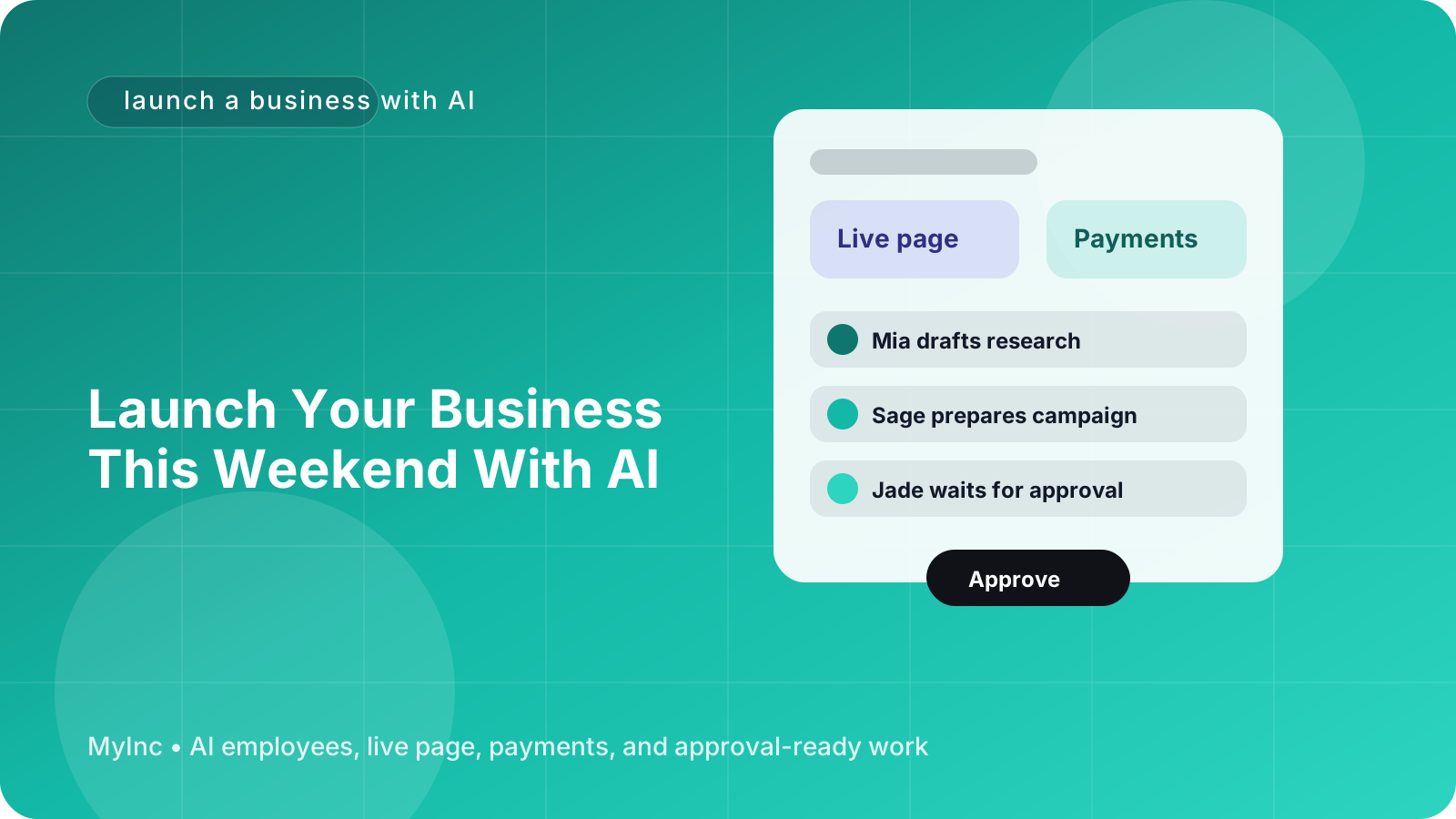
They do not make every decision for you. A good workflow keeps you in control: the AI team prepares the work, shows it to you, and waits for your approval before anything important goes out. You can edit, reject, or ask for a new version.
That matters when you are starting from scratch. Instead of opening ten tools and wondering what to do next, you have one place to turn a rough idea into an ordered launch plan.
Friday evening: define the smallest launch
Start by reducing the scope. Your weekend goal is not to build the final version of your company. It is to create a credible first way for a specific person to understand your offer and take the next step.
Write short answers to these questions:
- Who is the first customer you want to help?
- What frustrating problem do they have?
- What result can you help them achieve?
- What is the simplest offer you can deliver in the next two weeks?
- What should the customer do on your page: buy, book a call, join a waitlist, or send an inquiry?
For example, your offer might be a 90-minute website review for local consultants, a four-week beginner fitness plan for busy parents, a paid workshop for freelance designers, or a setup service for small businesses that need better invoices.
Do not start with five packages. Pick one. A single offer gives your AI team enough direction to produce useful work, and it gives potential customers a clear decision.
Then ask your chief of staff AI teammate to turn your answers into a weekend launch brief. Ask it to identify missing information, suggest a simple offer structure, and list the decisions you need to make. This prevents the common mistake of asking AI to invent a business without your judgment.
Saturday morning: generate your live page
Your page only needs to answer the questions a potential customer has before taking action:
- What is this?
- Is it for me?
- What problem does it solve?
- What exactly do I get?
- Why should I trust you?
- What happens after I click the button?
Ask your AI content teammate to draft the page using a simple structure:
- Headline: State the customer and the result in plain language.
- Problem: Describe the situation your customer recognizes.
- Offer: Explain what is included and what is not.
- Proof or credibility: Use your experience, process, examples, or a transparent explanation if you are new.
- Process: Show the three or four steps from purchase to delivery.
- Price and call to action: Tell people what to do next.
- Questions: Answer the objections you expect to hear.
A weak headline says, “Transform your business with our innovative solution.” A clearer one says, “Get a practical marketing plan for your consulting business in one week.”
Give the AI teammate your real details and ask it not to exaggerate. Do not let it invent client results, qualifications, testimonials, or guarantees. Review every factual claim before approving the page.
The page should be specific enough that a stranger can understand it in under a minute. If you are offering a service, explain the deliverable and timeline. If you are launching a course or workshop, explain the outcome, schedule, and format. If you are building software, describe the job it helps users complete.
Saturday afternoon: set up your business email
A business email makes it easier for people to trust and contact you. It also gives you a reliable place for customer questions, receipts, scheduling, and follow-up instead of mixing everything with a personal inbox.
Choose a simple address connected to your business name, such as [email protected] or [email protected]. Keep the address easy to say and type.
Prepare three basic messages before you launch:
- Inquiry reply: Confirm that you received the question and explain when you will respond.
- Purchase or booking confirmation: Tell the customer what happens next and where to get help.
- Follow-up: Ask whether they need anything and invite a useful reply.
Your AI content teammate can draft these messages in your voice. Give it examples of how you normally write, then remove anything that sounds too formal, vague, or robotic. A short, warm message is usually better than a long automated-sounding one.
Also decide who owns the inbox. Even if the AI team drafts replies or sorts incoming questions, you should know when a message requires your personal answer. Set expectations clearly rather than promising instant support you cannot provide.
Saturday evening: create your Stripe checkout
A page is not a launch until a customer can take the next step. For a paid offer, that usually means creating a Stripe checkout option with a clear product name, price, billing type, and customer information.
Before connecting payments, decide:
- Is this a one-time payment or a subscription?
- What is the exact price and currency?
- What does the buyer receive immediately?
- When and how will you deliver the work?
- What is your refund or cancellation policy?
Keep the first checkout simple. One product and one price are easier to explain and test than a confusing menu of options. Use a customer-facing name that matches the page, and make sure the checkout description sets accurate expectations.
An AI launch teammate can help draft the product description, confirmation instructions, and payment FAQ. You still need to connect your Stripe account, verify the financial details, and approve the final setup. Never skip the test purchase. Check the confirmation page, email, receipt, and any next-step instructions as if you were a customer.
Sunday morning: run a full launch rehearsal
Do not assume the flow works because each individual part looks finished. Test the journey from a customer’s point of view.
Use this checklist:
- Open the page on your phone.
- Read the headline and explain the offer in one sentence.
- Click every button and link.
- Send a test inquiry to the business email.
- Complete a Stripe test payment or follow your chosen payment-testing process.
- Confirm that the customer sees the correct next step.
- Check that you receive the notification.
- Look for spelling, pricing, date, and contact-detail errors.
- Ask one person unfamiliar with the idea what they think happens next.
Give your AI team the results of this rehearsal. Ask the chief of staff teammate to turn the feedback into a short list ranked by importance. Fix anything that blocks understanding, payment, or delivery before polishing colors and wording.
Sunday afternoon: launch to a small audience
You do not need a huge announcement. Start with people who are likely to understand the problem: former colleagues, community members, existing contacts, or a small professional group where relevant.
Ask your marketing or social AI teammate to draft three versions of a launch message:
- A personal note to someone who may benefit.
- A short social post explaining the problem and offer.
- A direct message asking for feedback without pressuring someone to buy.
Keep the message specific. Say who the offer is for, what it helps with, and where to learn more. Do not describe the business as “finally live” without explaining what a person can actually do.
Track questions, not just clicks. If several people ask the same thing, the page needs that answer. If people understand the offer but hesitate at the price, learn why before changing it. Your first launch is a learning loop, not a final judgment on the business.
Three rules that prevent an AI-assisted launch from going wrong
Give context, not just commands. “Write a website” is too vague. Include your customer, offer, price, tone, delivery process, and limits.
Ask for drafts, not blind automation. Let the AI team prepare the page, messages, and checkout copy, but review claims, prices, policies, and customer promises yourself.
Choose clarity over volume. One useful page, one offer, one email address, and one checkout are enough for a first test. More assets do not automatically create more demand.
FAQ
Can I really launch a business in one weekend?
You can launch a simple, testable version of many businesses in a weekend, especially a service, consulting offer, workshop, digital product, or early software waitlist. You may still need licenses, legal documents, specialized delivery systems, or additional product development. Treat the weekend launch as a first version, not permission to ignore those requirements.
What if I do not know exactly what my offer should be?
Start with the customer problem you understand best and choose a small result you can deliver quickly. Ask your AI team to suggest three offer options, compare their difficulty and customer value, and identify the assumptions behind each. You make the final choice based on your experience and access to customers.
Will the AI team publish things without my permission?
The right setup keeps you in control. The AI team should prepare drafts and recommendations, then wait for your approval before important page changes, customer messages, launch posts, or payment details go live. Review financial, legal, and factual information especially carefully.
Let MyInc.app take the weekend setup off your plate
The hard part of launching is often not the idea. It is coordinating all the small tasks that turn the idea into something people can see, contact, and buy from. MyInc.app gives you one AI team for that work: a chief of staff plus launch, marketing, social, and content AI teammates.
MyInc.app’s AI team can help solve three immediate problems:
- No live home for the idea: it helps build and organize your founder page and first offer copy.
- No professional way to communicate: it helps set up your business email and draft customer-ready replies.
- No simple way to get paid: it helps prepare your Stripe payment and checkout details so customers can take the next step.
You stay the decision-maker. The AI team reads your context, builds the drafts, organizes the launch checklist, and waits for your approval before the work goes out. Instead of stalling on setup, you can spend your weekend making the important calls and testing whether real people want what you are offering.
Ready to stop postponing your launch? Start MyInc.app for free and let the AI team take this exact setup work off your plate.